
The four-model mistake: why B2B founders keep picking the wrong marketing team
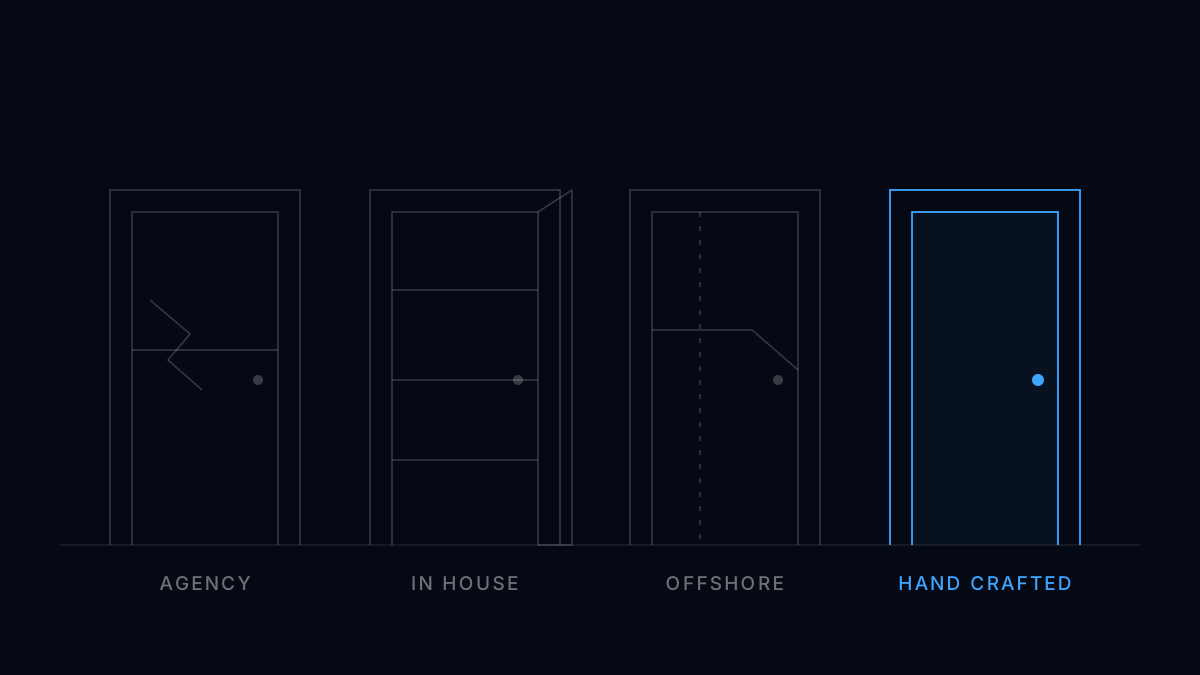 Every B2B founder walks up to the same three doors. The fourth is usually not on the map.
Every founder building a B2B company between $1M and $30M ARR faces the same decision at some point: marketing is not producing the pipeline the business needs, and something has to change. The team looks at three options: hire an agency, build in-house, or ship it to a cheap offshore team. Each has a Google search behind it, a peer who did that thing, and a spreadsheet that makes it look defensible.
All three fail for the same underlying reason, and it is not the one the sales pitches talk about.
The three models everyone shows you
The orthodoxy is well documented. A generalist agency runs your paid, your content and your email out of a shared team, most of whom are two years out of school. An in-house build starts with a marketing coordinator and grows into a team of eight to twenty people over eighteen months, driven by internal politics as much as by demand. Or a founder hires offshore contractors at a quarter of the price and hopes competence catches up with cost.
Each model comes with a plausible story. Agencies buy you speed and breadth. In-house buys you loyalty and depth. Offshore buys you margin. The 2026 industry numbers even back parts of the case. Companies that outsource marketing see 43% higher ROI on the money spent, and a fully loaded three-person in-house team costs $250K to $400K annually while an outsourced equivalent runs 40 to 65% less at the same stage.
The problem is not that the numbers are wrong. The problem is that the three models optimize for the wrong constraint.
What actually breaks in each one
The generalist agency breaks on craft. You are one of forty accounts. The senior on the pitch call is not the person writing your emails. The junior who runs your account is inheriting a template from three companies ago. What you get is competent-looking output that does not know your product well enough to make anyone stop scrolling.
The in-house build breaks on time to signal. A single marketing hire owns brand, content, web, paid and events, and does none of them at senior level. By month twelve you have a five-person team, still no attribution story, and a CFO asking why headcount grew before pipeline did. You did not buy a marketing engine. You bought a management problem.
The offshore team breaks on taste. Copy that reads as English but is not written in English. Design that follows the brief but does not know why the brief said what it said. The savings on hourly rate get burned back on the review cycles it takes to make the work usable, and sometimes the work never gets usable.
The common thread across all three is not effort. It is that the people producing the work are junior relative to the decisions their output represents.
The seniority of the person applying judgment matters more than the size of the team, the cost of the hour, or the length of the contract.
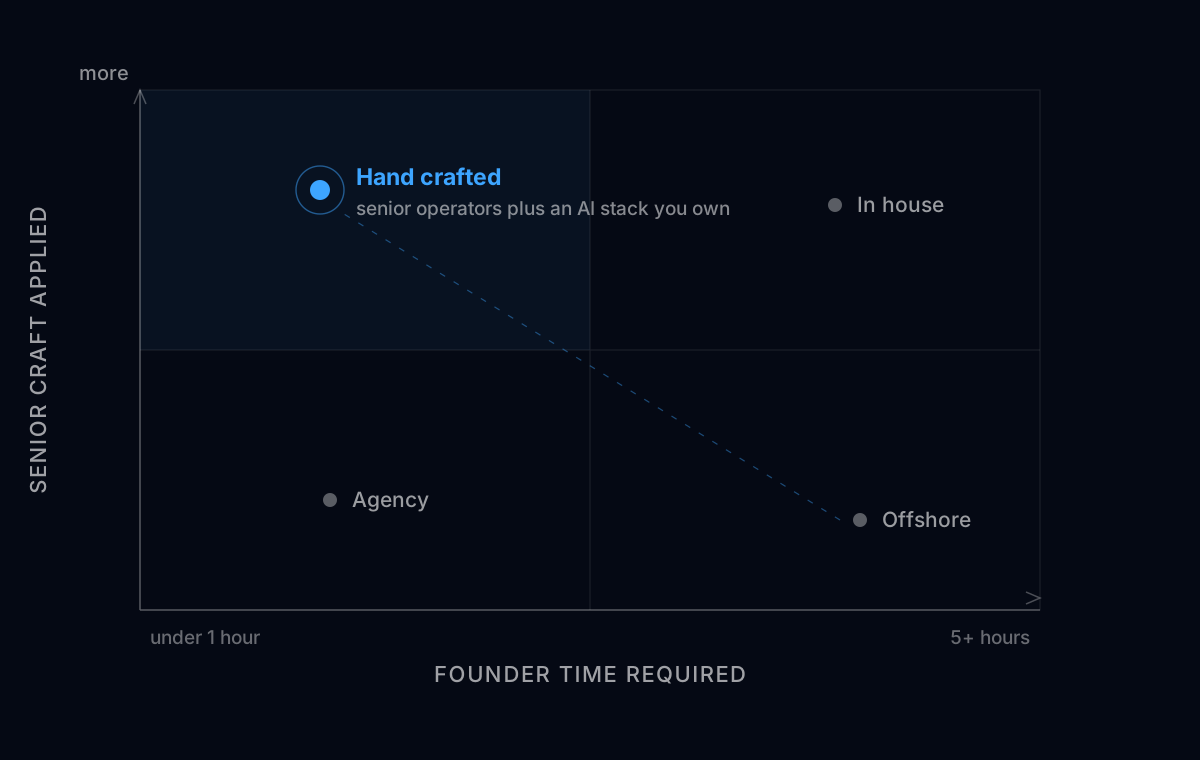 Where each model sits on senior craft. The fourth path is the diagonal the other three miss.
The fourth path
The fourth model is not a hybrid of the three. It is a different constraint entirely: senior operators doing the work by hand, on a small number of accounts, with the AI stack the client owns and runs inside their own business.
Senior operators means the person writing the LinkedIn post has actually run a marketing organization. The person shipping the landing page has built product marketing at a company that scaled. This is not a promise about seniority for the pitch deck. It is a constraint on how many clients one firm can take at once. The math forces it: a partner cannot personally handle 40 accounts, so a firm working this way stays small on purpose.
By hand means each brand system, each piece of content, each campaign build gets human decisions applied to it. AI is used the way any senior operator uses a tool: to move faster on the parts of the work that do not require judgment, and to leave the judgment alone. The output is craft. It is legible as human work because it is human work.
Custom AI stacks the client owns means the automation that runs inside your marketing operation, whether that is lead scoring, drip cadence, content ideation or reporting, gets built for you and deployed inside your infrastructure. When the engagement ends, the stack does not leave with the vendor. You keep the pipes. This is the opposite of the SaaS lock-in model, and it is the answer to the question every founder eventually asks: what happens when I want to bring this in-house.
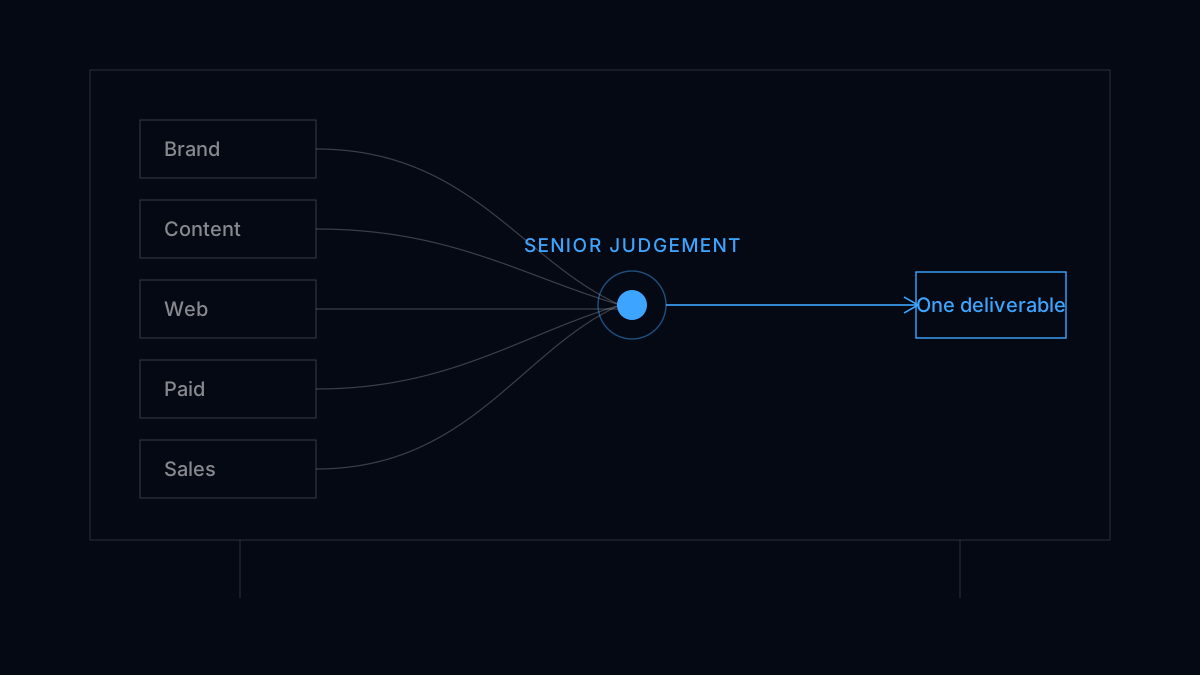 Hand-crafted means the person applying judgment has done the work at scale before, not that the output is slow.
The trend that makes this possible now
Two things changed in 2026 that make the fourth path viable in a way it was not two years ago.
The first is that 96% of B2B marketers now use AI tools at some point in their workflow, which means AI proficiency is table stakes rather than a differentiator. Senior operators can now execute at a speed that used to require a full team, because the leverage is real. A single senior with the right stack can output what a five-person coordinator team produced in 2023, and the work is better because taste is applied to the output.
The second is that experience marketing is becoming en vogue again precisely because AI has flooded the field with robo-crafted content. Founders and buyers can smell AI-generated copy inside three sentences. Marketing that reads as written by a person with an opinion now stands out in a way it did not when the average was already competent. Craft is a moat now, not a nice-to-have.
Put those two together and the economics change. The senior operator with an AI stack is faster than the agency, cheaper than the in-house build, and the output is legible in a way that offshore or generic-agency output is not. This was not true in 2023. It is true in 2026.
Craft is a moat now, not a nice-to-have. Buyers can smell AI-generated copy inside three sentences.
How to actually pick
The most useful reframe I have found is this: stop asking who to hire, and start asking what you are willing to stay involved in.
The honest question is not agency vs in-house. It is: how much of my week am I going to spend on marketing decisions in the next twelve months? If the answer is five hours or more per week, in-house works. If the answer is two hours, agency works, but only if the agency is small enough that you get the senior in the room. If the answer is under an hour, the fourth path is the only one that survives, because senior operators can carry the decisions the founder does not have time to make, and the AI stack carries the execution the founder will never see.
The involvement matrix
| Founder time per week | Model that works |
|---|---|
| 5+ hours | In-house team (you own the calls) |
| 2 hours | Small senior agency (partner in the room, not the account manager) |
| Under 1 hour | Hand-crafted firm with senior operators plus an AI stack |
| Zero, but expects results | None. Fix the time first. |
FAQ
Do B2B founders actually need a marketing team, or should they just use AI tools? Founders under $1M ARR usually do not need a team, they need a system. Founders between $1M and $30M ARR need someone who owns the pipeline output, whether that is one senior operator, an in-house head of marketing, or a small firm working with them by hand. Above $30M ARR the question shifts to in-house depth. Below $1M ARR the AI tools alone are enough, because you are still figuring out the message.
How much should a B2B company between $1M and $10M ARR spend on marketing? Industry benchmarks put B2B marketing spend at 7 to 12% of revenue at growth stage, but the ratio matters less than what the money buys. If it buys senior decisions, 7% is enough. If it buys junior execution, 12% is not.
When is it too early to hire an agency? When the founder cannot articulate the core positioning in two sentences. No agency of any quality can produce meaningful work without a clear positioning input, and the founder is the only person who can produce that input. Fix positioning first, then hire.
Can AI replace a marketing team entirely? Not at B2B scale, not in 2026. AI handles execution well. It does not handle brand strategy, positioning under competitive pressure, or the taste calls that separate work that lands from work that reads as filler. The founders who are trying to run marketing purely on AI in 2026 are the ones producing the content the buyers are learning to skip.
What does "hand-crafted marketing" actually mean? It means the person applying judgment to the work is senior, the output is not templated, and the AI is used the way a designer uses Photoshop: as a tool that speeds up the parts of the work that do not require taste, and stays out of the parts that do. The final call on every piece is made by someone who has done the work at scale before.
Who we are and what the engagements cover are both a page away, and the work itself is on our work page.
Recognise your own situation in one of the four? Tell us where it is breaking. Twenty minutes, and you get back which model fits, including when it is not us.